The observation
Everyone sells the same discount
Every outdoor hospitality sales funnel opens with a coupon. I wondered whether a discount asks guests to think about price before they’ve had the chance to imagine themselves there.
As I started to think about how we’d attract guests, I did what founders are supposed to do. I talked to the people who market unique stays for a living.
I approached a handful of marketing agencies specializing in outdoor hospitality. Until now, we’d been fortunate enough to ride the support of our backers, but I wanted to look around the corner. Eventually, we’d need to attract guests who’d never heard of Menizei.
The proposals came back between $4,000 and $15,000 a month. Perfectly reasonable if you’re building for scale.
I’m not.
So I did what engineers do whenever a process seems mysterious — especially an expensive one.
I reverse-engineered it.
I signed up for twenty-three sales funnels built by three of the busiest agencies in the category. The emails weren’t rocket science. They were surprisingly formulaic and, if I’m honest, easy enough to replicate.
What caught my attention wasn’t the copy. It was the pattern.
Different brands.
Different aesthetics.
Different copy.
Almost identical strategy.
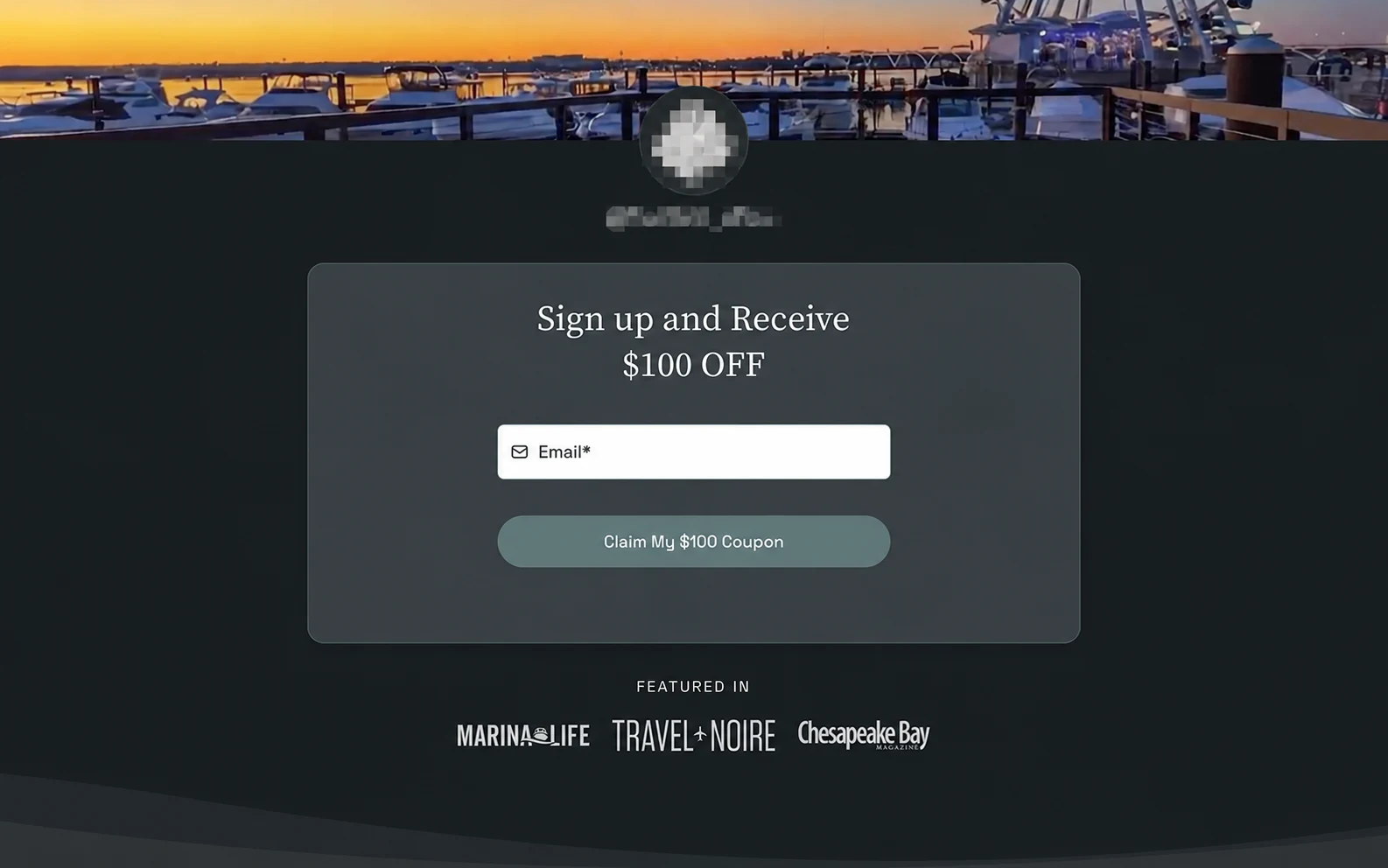
“Give us your email and we’ll give you $100 off.”
Every funnel opened the same way: with a discount.
Everyone appreciates a good deal. But I couldn’t shake the feeling that something was off. If a guest’s very first interaction with your stay is a bargain, what expectation have you just set?
Premium experiences have to be imagined before they can be evaluated. Guests need to picture themselves there. They need to feel the pull of the destination before they start weighing whether it’s worth the price.
A discount flips that sequence. Instead of inviting guests into the experience, it invites them into a calculation. It asks them to evaluate the price before they’ve had the chance to decide whether they even want the experience.
That felt fundamentally at odds with what Menizei is trying to create. Menizei isn’t built around discounting. It’s built around Forest Cocooning.
So I started wondering:
Is a coupon really the only way to attract guests?
The hypothesis
Could discovery outperform a discount?
Was a $100 discount really the only way to earn a subscriber? I made three predictions.
Subscribers would opt in for the right reason. A coupon gives every subscriber the same motivation: saving $100. I wanted to know what would happen if people subscribed because they were drawn to the experience instead.
The funnel could capture the guest’s point of departure. Every transformation begins by leaving something behind. Instead of asking for an email in exchange for $100, I wondered what would happen if we first asked guests what they were hoping to leave behind. The answer would become the starting point for everything that followed.
Understanding intent would prove more valuable than collecting email addresses. A discount tells me someone wanted to save money. It doesn’t convey why they were drawn to Menizei in the first place. If I could capture that intent instead, I’d learn something a coupon never could.
The make-over
The Retreat Profile Quiz
I scrapped the discount entirely. Instead of offering $100 off, I asked visitors why they were looking for an escape in the first place.
I didn’t lead with a discount.
I led with a question.
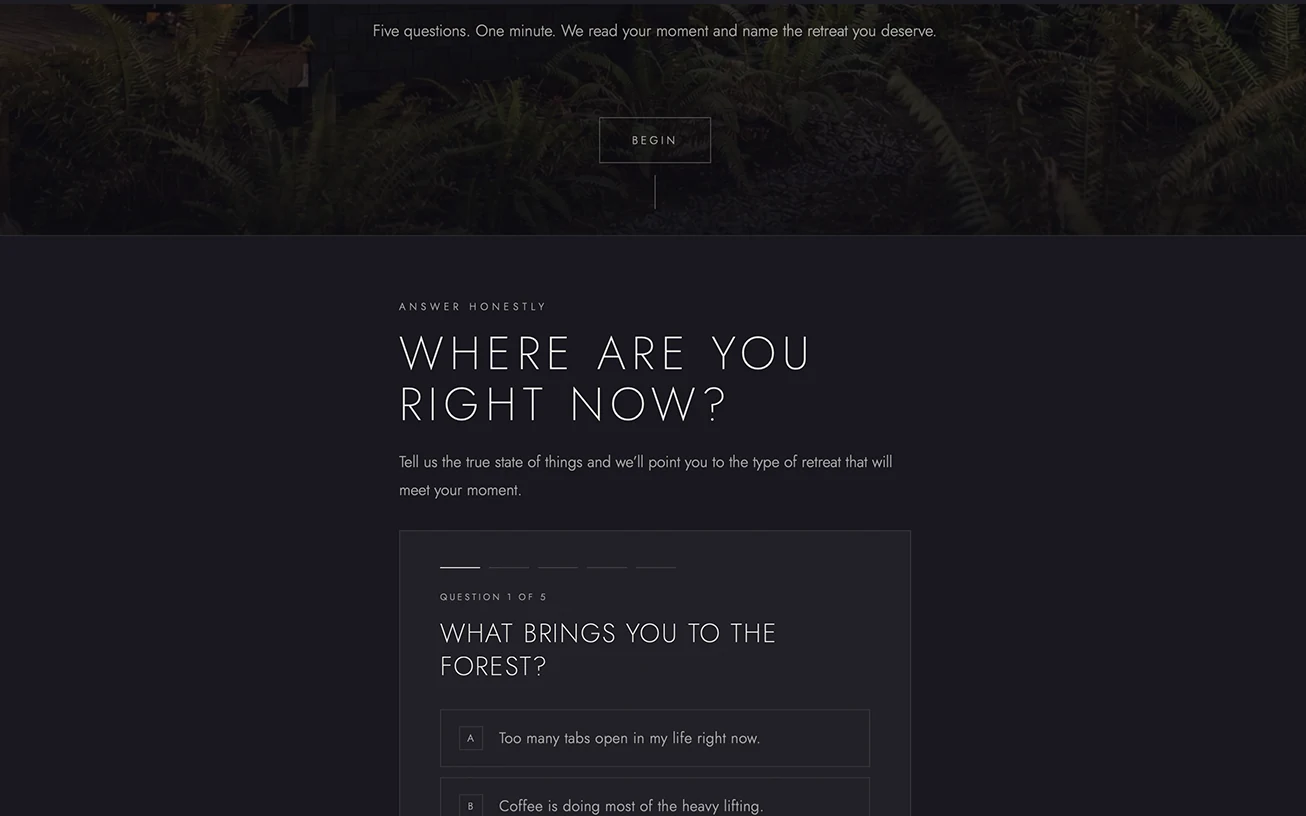
In place of “Enter your email for $100 off,” the landing page asks a single, disarming question:
Where are you right now?
From there, visitors move through a short series of questions designed to uncover what they’re hoping to leave behind, and why the forest appealed to them in the first place.
They receive a Retreat Profile: a reflection of their current state, the transformation they’re seeking, and whether Forest Cocooning is the right prescription.
The email address is still captured.
But only after they’ve diagnosed themselves.
What happened
What a coupon could never tell me
It’s still too early to draw conclusions about conversion rates. But after three weeks, the experiment had already revealed the one thing a discount never could: why guests were searching for an escape in the first place.
I’ll be honest about what I can’t tell you yet.
Menizei is intentionally small, and meaningful conversion data takes time. Whether this approach ultimately outperforms a traditional discount is a question for an incoming Receipt.
What I can tell you is this.
In three weeks, 245 people completed the Retreat Profile Quiz.
They didn’t just leave behind email addresses.
They told us what they were hoping to leave behind.
A discount would have given me a spreadsheet of subscribers and a single number: how many.
The quiz gave me something far more valuable.
It told me why.
| What the guest gave | And what it bought us |
|---|---|
| An email addressthe same field every funnel asks for | a name on a list |
| Two minutes and an honest answerwhy they’re looking for the forest | their intent |
| Discount spent to learn it | $0 |
Same email a coupon would have bought — plus the one thing a coupon can’t: why they came looking. The conversion numbers are still coming.
What surprised me
Deep sleep beat the anniversary
We built Menizei for couples, so I assumed Anniversary would finish first. It didn’t. But that wasn’t what surprised me most.
I genuinely expected Anniversary to top the list. Menizei was designed around couples celebrating milestones together, so it seemed like the obvious answer.
Instead, Deep Sleep edged it out by a single response.
That was surprising.
Sleep tourism has been gaining attention for years, but I’d assumed it was fading in favor of the louder narrative around burnout. The quiz suggested otherwise. Deep Sleep finished first, while Burnout Recovery accounted for just 7 percent of responses.
Looking across all of the Retreat Profiles, another pattern emerged. Guests appeared far more interested in disconnecting than reconnecting. Deep Sleep and Urban Detox both outranked Reconnection.
But what surprised me most wasn’t any individual ranking. It was how quickly the rankings themselves became more valuable than the results.
Before the quiz, every landing page, email and package was built around what I thought prospective guests wanted. Within three weeks, I had 245 people telling me what they were actually hoping to leave behind. I could shape their journey of discovery around evidence instead of intuition.
One caveat is worth stating plainly. This isn’t a blueprint for hospitality. It’s a profile of Menizei’s guests. A different destination, designed for a different transformation, should expect a completely different ranking.
That’s what made the experiment worthwhile.
Not that Deep Sleep beat Anniversary.
That I no longer had to guess.
One actionable takeaway
Audit your first click
Audit the first interaction in your sales funnel. Does it help prospective guests understand themselves — or simply incentivize them to subscribe?
Open your landing page the way a stranger would. Ignore everything after the first interaction and ask yourself a simple question: what is the very first thing I’m asking a prospective guest to do?
If the answer is “Enter your email for a discount,” pause there.
Not because discounts don’t work. Clearly they do, or every outdoor hospitality marketing agency wouldn’t rely on them.
But because you might gain something far more valuable than an email address.
Ask yourself what you could offer instead. How could your first interaction help a prospective guest better understand what they’re actually seeking while they’re still in discovery?
You don’t need a Retreat Profile Quiz.
You need a first interaction that begins the experience you’re uniquely positioned to create, rather than rushing toward the transaction.
Because understanding why someone wants the getaway is far more valuable than paying for their email.