The observation
Kept hostage by my property management system
Hostaway charged a subscription and then took commissions on top. I kept the receipts.
The whole promise of direct bookings was no more commission fees.
A property management system (appropriately acronym’d PMS) is the software many operators use to manage reservations, guest messaging and connect to booking channels. My PMS, Hostaway, also powers my own booking site — and that’s where direct bookings come into play. With Hostaway, guests are able to book Menizei directly, with no middleman (like Airbnb and Booking.com) skimming a cut.
Then, in late 2024, Hostaway trampled that promise. Already charging a hefty subscription (increased relentlessly each year — and now $120/mo), they started taking their own cut of every booking. But unlike Airbnb and Booking.com, they brought me exactly zero bookings.
| What the same software costs me | Before | Now |
|---|---|---|
| Software subscription | $120 | $120 |
| Guest fee1.8% of ~$49,882/mo booking revenue | — | $898 |
| Application fee1% of ~$49,882/mo booking revenue | — | $499 |
| Per month | $120 | $1,517 |
| Over 7 months | $840 | $10,617 |
Two separate Hostaway fees — a 1.8% guest fee and a 1% application fee, 2.8% all in. All on the very channel that “direct” was supposed to keep commission-free. Same software, more than 12× the cost.
I don’t begrudge the subscription. I work in software and it ain’t going to maintain itself. (Well — not before agentic workflows.)
But a commission on top? Greedy. I tried like hell to leave — Guesty, Hospitable, Mews — but they either wanted me on Airbnb or couldn’t import my history. All of them wanted me to adopt their assumptions: their booking flow, their guest journey and their idea of what hospitality should look like.
Hostaway had me, and they knew it: the yearly hikes kept coming, right alongside a commission they never earned. I stayed like a little bitch. But this bitch holds a grudge like no other. I keep receipts.
I lead an engineering team at Apollo GraphQL, where we push each other to get more out of AI. I took the challenge home too. The more I experimented — and the more Anthropic shipped — the more I believed that with the right guardrails (and a shit-ton of documentation), an agent could build a serviceable app, not just serviceable code.
The question I started with was:
Which PMS should replace Hostaway?
But the advance of AI agents allowed me to ask a more interesting question:
What if I replaced the whole stack?
So came the dreams of grandeur: replace the whole hospitality stack, one SaaS at a time. Not Hostaway first — that’s a lot; first, I needed to build my vibe-coding muscle before taking on a PMS. So I started with the easy one: Menizei’s mostly static marketing website.
The hypothesis
Three reasons this experiment could pay off
Three bets: save money, get pixel-perfect control and finally run my own experiments.
Save money. Webflow’s $25/mo was reasonable; learning it myself wasn’t, given the day gig plus Menizei. So I leaned on Fiverr. I uncovered the occasional gem, but I mostly paid for mediocrity — ~$350/mo on average. All in, I’m betting that killing Webflow and my Fiverr habit pencils out to $5,100 a year.
Achieve pixel perfection — without a cost to performance. I’m persnickety — most designers are — and few humans, never mind Fiverr freelancers, tolerate my fetish for UI nirvana. Claude does. As long as I pay the subscription, it keeps pushing the pixels. What’s more, I’m betting that with Claude keeping me honest and holding me to best practices, I can get the UI to load faster.
Customize guest discoverability. I have opinions about how a booking site should guide guest discovery of a stay. Reputable hospitality dev shops were never game to experiment — they profit from repeatable solutions tuned for the aggregate, a.k.a. the lowest common denominator. Instead of a category-of-one experience for a category-of-one stay, I was stuck with the same template everyone else had. I’m betting I can create a custom user experience (more on that below) that lifts dwell time and lowers bounce rate.
The make-over
The entire website rebuilt to optimize guest discovery
The entire website rebuilt: lighter, faster and exactly to spec.
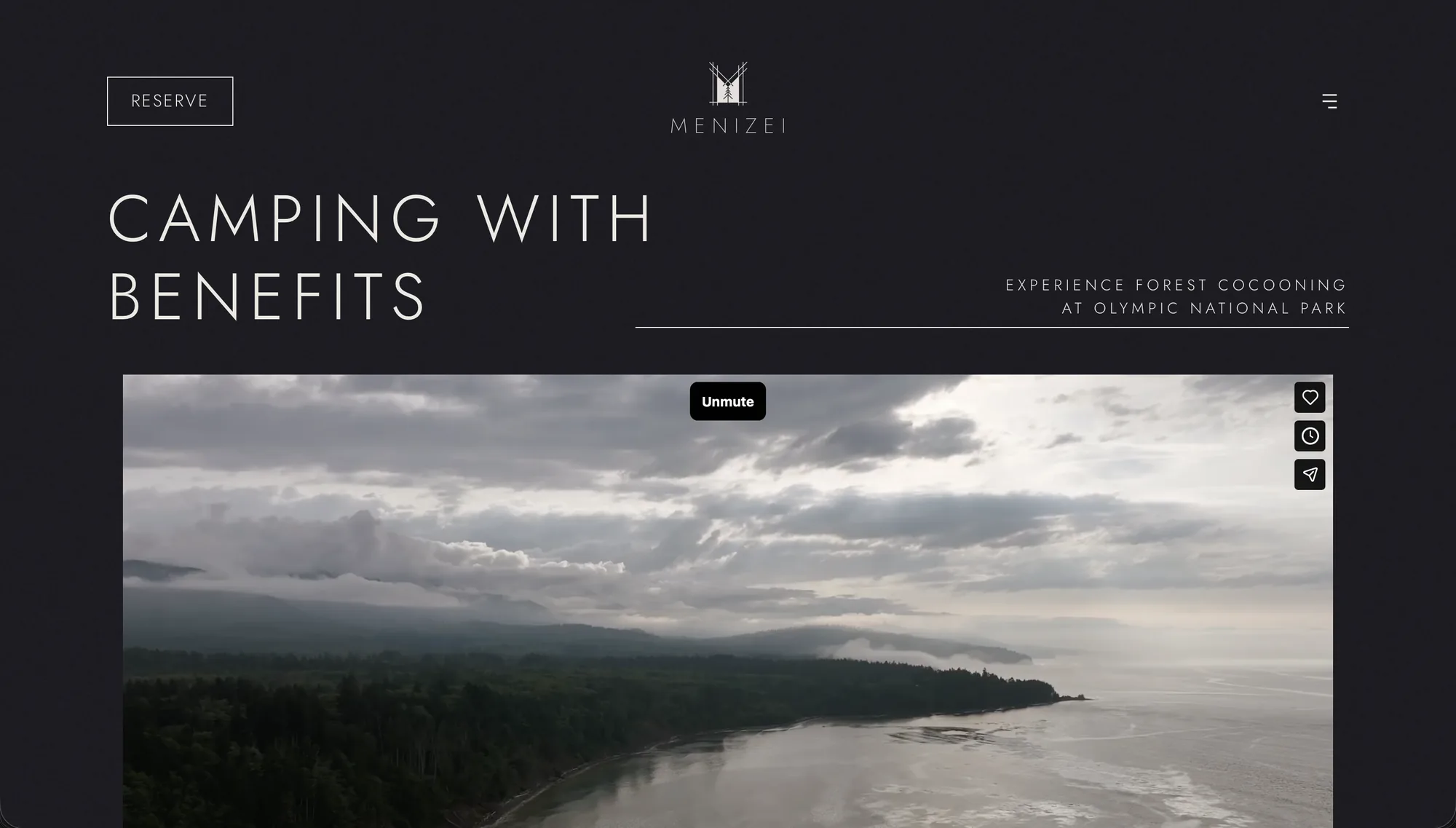
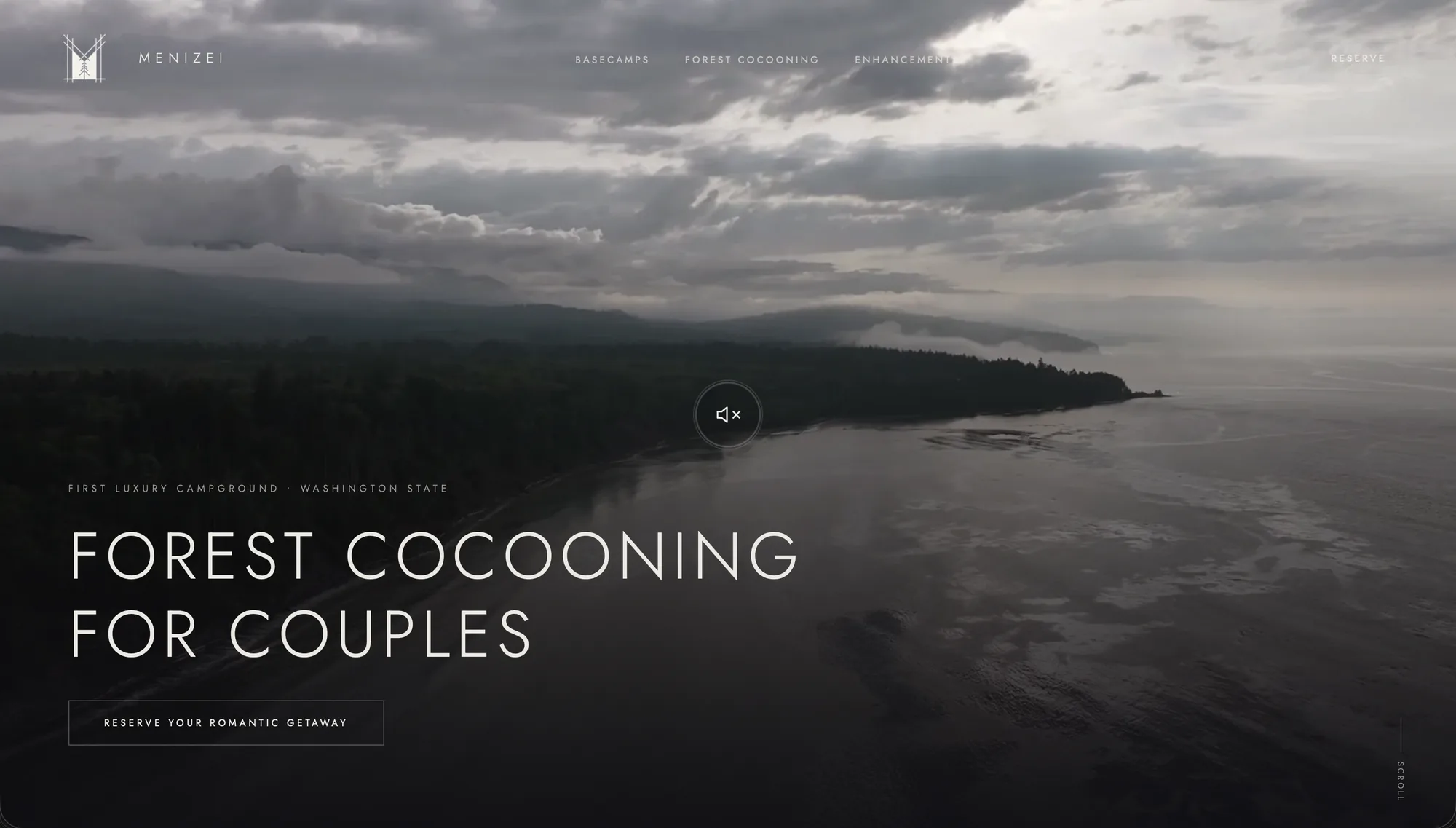
What I ordered. When I say Forest Cocooning, I mean it. Menizei is tucked in dense coastal rainforest perched on a 200' bluff — damn near impossible to capture in stills. Guests won’t book what they can’t understand, and video does a much better job of explaining. Trouble is, video usually drags performance, which then drags SEO.
I also wanted guests to choose their own adventure — or rather, their own retreat: I wanted a landing page that was not just interactive, but responded to guest intent.
With Claude, I served up exactly what I ordered.
How long it took me to serve. Ten days. I mostly used Sonnet, with Opus on codebase reviews, testing and cleanup. And that’s ten calendar days, not working days — between Apollo and Menizei, really five nights and two weekends.
Screenshots don’t do it justice — tap the before to walk the old Webflow site, the after to see it live.
What happened
Did the bets pay off?
A faster site, ~$4k/yr saved and the first experiment underway and collecting data.
-
How much did I end up saving? Menizei is deployed on Vercel, which costs $20/mo, so I essentially traded one subscription for another — no real savings there. The real receipt: no more hunting for the needle-in-a-haystack freelancer with both an eye and a facility for code. That’s a savings of $4,200 a year. While not the full $5.1k, I’m calling this a win.
Freelance design + devthree-year average ~$350/mo → $0 ≈ $4,200/yr saved -
How did the pixels turn out? And do those pixels load faster? I leave it to you to decide whether the UI is more pleasing. But performance I leave to Core Web Vitals. Menizei’s site went from mostly orange to nearly all green. For anyone who still gives a shit about SEO — I do — that’s huge. Especially given the heavy use of visuals, including video.
Lighthouseold Webflow → the rebuildPerformance57→98SEO69→100Accessibility93→96Best Practices58→58Agentic browsing2/3→3/3Four of five leapt — Performance nearly doubled, SEO maxed at 100. Best Practices stuck at 58, exactly where Webflow left it — that’s on Vimeo hosting our hero video, not the stack.
Don’t take my word for it — run them yourself: -
What happened to dwell time after experimenting with the home page? Menizei is high-ticket with a long conversion cycle, so my first target is discovery, not bookings: the longer someone sits with Forest Cocooning, the likelier Menizei comes to mind when the occasion does. What happened (and didn’t) actually deserves its own article. (Coming soon!)
What surprised me
Humans still needed in the loop
The bottleneck wasn’t the building. It was the human judgment — knowing what’s worth keeping, and writing the words Claude couldn’t.
The power went straight to my head. What would’ve taken me weeks — months given my day gig — Claude did in a day. Heady, and it gets to you fast. The skill I needed most wasn’t prompting, it was discipline. Building is easy, addictive even. Making sure what’s built is more than a vibe takes the unsexy stuff: code reviews, tests, docs and refactors to triage the debt before it buries the site.
Claude’s design chops. At the end of the day, Claude is an autocomplete engine — not yet capable of true genesis. But it autocompletes from a world of tried-and-true design approaches. So given a solid foundation it’ll surprise you with its refined taste. That if does a lot of work: without the foundation, there’s nothing good to autocomplete from, and it goes off the rails fast.
Claude’s copy chops. Or lack thereof. Even fed everything I’ve ever written, it couldn’t land my elevated-but-cheeky tone. It can do granola. It can do abstract. (Already the house style of far too many hospitality sites.) I spent more time rewriting copy than code and am still converting Claude-copy to Janice-copy. See if you can spot the seams.
The roadmap
Replace the entire SaaS hospitality tech stack
Webflow and freelancers are out. Hostaway’s being supplanted as you read this article.
The website was the warm-up. I’ve started, with glee, to dismantle Hostaway. And once you’re no longer constrained by software built for the masses — which is to say software not meant for anyone building category-of-one stays — it’s downright dazzling what software can do to enhance the guest experience. And don’t get me started on operations.
This isn’t a 10-day project. And in parallel, I’m building a home-grown analytics engine for Menizei on PostHog. It’s hard to keep receipts without data.
| Before | After | Status |
|---|---|---|
| WebflowMarketing site | Next.js app hosted on Vercel with PostHog for analytics | Live |
| TouchStayGuest guide to Forest Cocooning | Trail Notes — one living page per stay, built into Menizei OS | In progress |
| HostawayReservation system | Menizei OS — a custom reservation system on a Neon Postgres backend | In progress |
| ZapierAutomation and guest messaging | Menizei OS — scheduled on Vercel Cron, email via Resend and text via Quo | In progress |
| Website checkout | Agentic booking, exposed over an API | Coming |
| Website | A guest-promptable site using AG-UI | Coming |
One actionable takeaway
Go take stock
Walk your own booking flow like a first-time guest — or have someone else do it — and write down every paper cut. Then ask how you’d fix it without an off-the-shelf website in the way.
It’s amazing how numb we get to paper cuts on repeat. I’m on Week 3, and only now am I shaking off the PMS-template shackles — and really diving into guest experience as it could (and, to be proven, should) be.
Go look at your own marketing website. Book a stay like a first-time guest — better yet, hand it to someone who hasn’t lived and breathed the thing. Write down every paper cut and every question. Then ask how you’d fix each one without a lowest-common-denominator site in the way.